The Growing Influence of Social Impact Consulting Firms in India
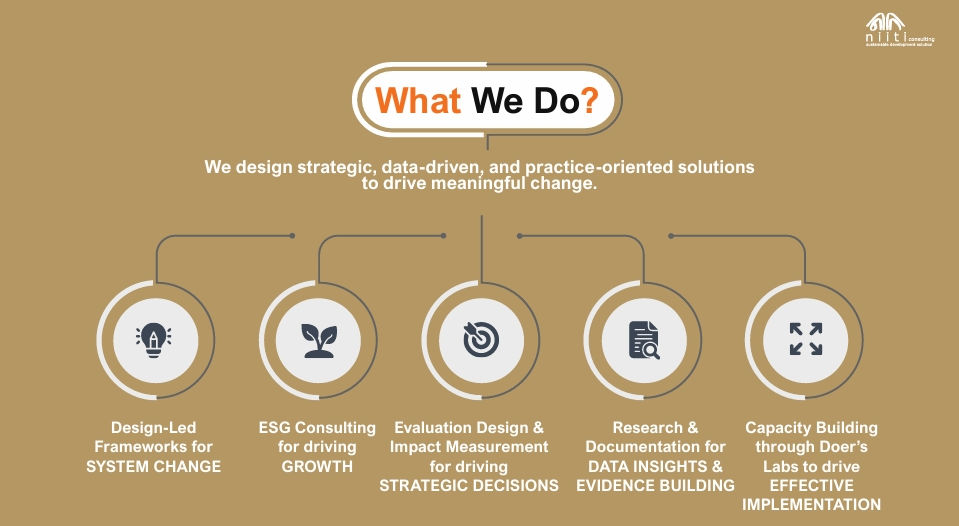
India’s socio-economic landscape is experiencing a significant transformation as enterprises, charities, and impact-oriented leaders align financial returns with social objectives. Across sectors such as education, healthcare, livelihoods, sustainability, and cultural preservation, there is a rising awareness that tangible social value can align with financial sustainability. In this transforming landscape, social impact consulting firms in India play a pivotal role in guiding strategy, enhancing governance, and driving initiatives toward sustained, meaningful impact rather than superficial gains.
These consultative bodies work where public policy, enterprise, and grassroots development converge. Their work involves assessing impact models, designing scalable interventions, improving monitoring frameworks, and helping institutions access responsible funding. As the country continues to foster inclusive growth, the demand for structured expertise in impact measurement and sustainable innovation is steadily rising.
Why Social Impact Consulting Firms in India Matter Today
India’s multifaceted social challenges require more than good intentions. It requires evidence-based planning, operational discipline, and contextual insight. Social impact consulting firms in India close the divide between ambition and implementation by providing systematic frameworks that translate concepts into actionable programmes.
Such firms commonly assist organisations with baseline assessments, stakeholder analysis, programme structuring, risk assessment, and impact documentation. They help clients synchronise initiatives with compliance standards while building accountability systems that appeal to ethical investors and institutional stakeholders. In a market where accountability and measurable results face growing scrutiny, such expertise builds trust and long-term stability.
In addition, impact advisors support corporations in designing robust corporate social responsibility frameworks. Instead of isolated philanthropic efforts, businesses are guided towards integrated social investment frameworks that support communities while strengthening brand trust and long-term competitiveness.
The Emergence of Social Entrepreneurship in India
Parallel to consulting growth, social entrepreneurship in India has witnessed notable growth over the last decade. Social entrepreneurs integrate entrepreneurial skills with a purpose-driven approach to societal problems. Rather than depending entirely on charitable funding, they create income-generating structures that maintain long-term impact.
India’s demographic diversity, rural-urban disparities, and digital expansion have created fertile ground for such ventures. Social enterprises are tackling issues ranging from rural financial inclusion and affordable healthcare to waste management and women’s empowerment. Their success often depends on disciplined execution, structured impact evaluation, and growth-ready business frameworks — areas where social impact consultants frequently contribute.
The shift towards purpose-led enterprise reflects a broader evolution in thinking. Younger founders increasingly prioritise purpose alongside profit. Investors, too, are scrutinising ventures via ESG perspectives. As a result, the ecosystem supporting social entrepreneurship in India is becoming increasingly organised, analytics-focused, and innovation-led.
Cultural Entrepreneurship Examples in India and Their Influence
While technology-led innovation often dominates headlines, culture-based enterprises are equally important within the social economy. There are numerous cultural entrepreneurship examples in India where heritage art forms, crafts, performances, and traditions are renewed through viable business models.
Such initiatives may involve empowering artisan clusters, promoting indigenous textiles, reviving folk art forms, or creating platforms for local storytelling traditions. By combining modern design approaches with ethical trade and strategic market access, cultural entrepreneurs ensure that heritage becomes a sustainable source of livelihood instead of a declining tradition.
For instance, enterprises that organise rural artisan collectives often focus on capacity building, quality control, and market linkage strategies. They enhance production networks while safeguarding fair wages. In doing so, they preserve cultural identity and create dignified livelihoods. Consulting expertise becomes valuable here in areas such as measurement frameworks, market strategy, and structured growth.
Cultural entrepreneurship also encourages local pride and supports tourism growth. When local heritage is curated with care and authenticity, it creates income streams without compromising cultural integrity. These cultural entrepreneurship examples in India demonstrate how heritage and business can thrive together.
Nano Enterprises and Local Economic Empowerment
At the base of the economic social entrepreneurship in india pyramid, nano enterprises represent a foundational but under-recognised contributor to equitable growth. Nano enterprises are micro-scale, frequently home-operated ventures managed by individuals or families with limited capital. They may operate in areas such as garment work, food-based ventures, artisan crafts, neighbourhood retail, repair services, or farming-linked operations.
Despite their scale, nano enterprises collectively play a major role in creating jobs, particularly in rural and semi-urban areas. They provide economic support in areas lacking structured employment. However, these enterprises often face structural constraints such as limited access to credit, lack of digital literacy, inconsistent supply chains, and weak market integration.
Social impact consulting firms frequently assist organisations working with nano enterprises by designing micro-financing structures, skill development programmes, and digital enablement strategies. Through structured capacity-building initiatives, nano entrepreneurs acquire capabilities to boost output, maintain standards, and expand customer engagement.
The growth of nano enterprises is closely connected to women’s empowerment in India. A substantial proportion of nano entrepreneurs are women-led ventures functioning from home environments. By strengthening these enterprises, development initiatives advance income growth alongside gender equity and domestic resilience.
Integration of Consulting, Entrepreneurship, and Grassroots Models
The true strength of India’s impact ecosystem lies in the fusion of strategic advisory expertise, entrepreneurial drive, and community engagement. Social impact consulting firms in India provide the structural framework that enables social entrepreneurship in India to scale responsibly. At the same time, grassroots nano enterprises and cultural ventures ensure that impact remains community-centred and inclusive.
This integrated model ensures that innovation is not limited to urban hubs. Instead, it extends to rural groups, craft networks, and small business communities. Consultants help structure operations, evaluate performance, and plan scaling routes while respecting community contexts.
Technology also plays a crucial role in this ecosystem. Digital payment systems, online marketplaces, and mobile-based training tools are helping nano enterprises formalise operations. Social enterprises leverage technology to increase accessibility, gather live insights, and improve service models. Impact consultants evaluate these models to ensure growth without compromising purpose.
Impact Measurement and Accountability in the Indian Context
One of the most critical contributions of social impact consulting firms in India is building reliable impact assessment frameworks. As funding increasingly shifts towards results-driven financing and impact-oriented capital, transparent reporting has become non-negotiable.
Impact metrics may include progress across income, learning results, health benchmarks, environmental repair, or social participation. Consultants develop logical frameworks, theory-of-change models, and monitoring tools that align activities with measurable outcomes. This structured approach reduces inefficiencies and builds investor confidence.
For social entrepreneurship in India, rigorous impact measurement strengthens sustainability. Enterprises can demonstrate not only financial performance but also social return on investment. Cultural ventures and nano enterprises also benefit when their contributions are measured and articulated clearly.
Outlook for India’s Expanding Impact Economy
India’s socio-economic diversity ensures that the scope for social innovation remains extensive and varied. Urban innovation hubs, rural livelihood programmes, cultural enterprises, and micro-business clusters collectively create an interconnected impact environment. The collaboration between mission-driven entrepreneurs and experienced consultants will likely deepen as scrutiny around results and growth accelerates.
Government policy support, private capital, and community participation are coming together to strengthen impact systems nationwide. As the ecosystem matures, social impact consulting firms in India will continue to play a strategic role in aligning ambition with execution, ensuring that programmes remain both financially viable and socially meaningful.
The steady expansion of social entrepreneurship in India demonstrates that purpose-led business is not a niche concept but a mainstream economic force. Meanwhile, inspiring cultural entrepreneurship examples in India and the quiet resilience of nano enterprises highlight how inclusive growth must be rooted in community realities rather than abstract models.
Conclusion
India’s development journey is increasingly shaped by enterprises and institutions that prioritise measurable, sustainable impact. Social impact consulting firms provide the structure, strategy, and accountability required to transform ambitious ideas into scalable solutions. Social entrepreneurs translate purpose into operational ventures that address pressing challenges, while cultural enterprises and nano businesses ensure that growth remains inclusive and community-driven. Together, these elements form a robust ecosystem where profit and purpose coexist, reinforcing India’s path towards balanced and responsible progress.